
Copyright © 2025 AppsMinder. All rights reserved.
Copyright © 2025 AppsMinder. All rights reserved.
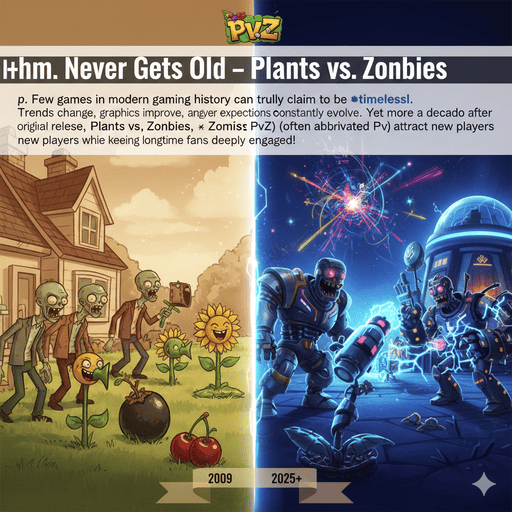
Few games in modern gaming history can truly claim to be timeless. Trends change, graphics improve, and player expectations constantly evolve. Yet more than a decade after its original release, Plants vs. Zombies (often abbreviated as PvZ) continues to attract new players while keeping longtime fans deeply engaged.
Originally developed by PopCap Games and later acquired by Electronic Arts, Plants vs. Zombies is often described as a tower defense game. However, that label alone fails to capture why the game has endured for so long and why its many versions still maintain strong download numbers across platforms.
At its core, Plants vs. Zombies presents an extremely simple idea: players defend their home from waves of zombies by planting various defensive plants. Each plant has unique abilities, costs, and cooldowns, while each zombie introduces new challenges.
Game design analysts from outlets such as Gamasutra (now Game Developer) have often cited Plants vs. Zombies as a textbook example of “easy to learn, hard to master” design. The rules are intuitive, but strategic depth emerges naturally as new mechanics are introduced.
This gradual complexity curve is one of the main reasons PvZ appeals to such a wide audience, from casual players to strategy enthusiasts.
Many games rely on visual spectacle or narrative twists to stay relevant. Plants vs. Zombies takes a different path—its longevity is rooted in system-driven gameplay rather than presentation alone.
Several key factors contribute to its lasting appeal:
According to PC Gamer, Plants vs. Zombies succeeds because it “respects the player’s time while still offering meaningful decisions.” This balance is increasingly rare in modern mobile and casual games.
One reason Plants vs. Zombies remains relevant today is the sheer number of versions and adaptations released over the years.
The original Plants vs. Zombies (2009) was followed by releases on PC, consoles, and mobile platforms, each tailored to its audience. Later, PopCap expanded the franchise with new mechanics, visuals, and even genres.
Plants vs. Zombies 2 introduced time-travel-themed worlds, bringing new environments, plant types, and zombie behaviors. It also adopted a free-to-play model, sparking debate among longtime fans.
While some players criticized its monetization, others appreciated the steady stream of updates, limited-time events, and evolving content that kept the game fresh.
The franchise later expanded into unexpected territory with titles such as Plants vs. Zombies: Garden Warfare, which transformed the series into a third-person shooter. This move demonstrated the flexibility of the PvZ universe and its strong character identity.
From a brand perspective, media outlets like IGN have noted that PvZ is “one of the rare casual franchises capable of surviving radical genre shifts.”
With so many versions available today, a common question arises: Which version of Plants vs. Zombies is the best?
The answer largely depends on what players value most.
This diversity allows the franchise to reach multiple audiences simultaneously—something few casual games achieve.
In an age dominated by aggressive monetization and short attention spans, Plants vs. Zombies stands out for its clarity of design.
Mobile gaming analysts frequently point out that PvZ’s interface, pacing, and visual readability make it especially well-suited for touchscreen devices. Even after countless updates and reinterpretations, the core gameplay loop remains intact.
This consistency helps explain why PvZ APK versions continue to see steady demand, particularly among players seeking offline-friendly or classic gameplay experiences.
Plants vs. Zombies is more than a nostalgic classic—it is a case study in how strong game design can outlive technological change.
Through multiple versions, platforms, and gameplay experiments, PvZ has remained recognizable, approachable, and fun. Whether you prefer the original experience or its modern adaptations, the franchise proves that great ideas truly never get old.
In a constantly shifting gaming landscape, Plants vs. Zombies reminds us that timeless design will always outlast trends.
ALL RIGHTS RESERVED AppsMinder.com 2025