
Copyright © 2025 AppsMinder. All rights reserved.
Copyright © 2025 AppsMinder. All rights reserved.
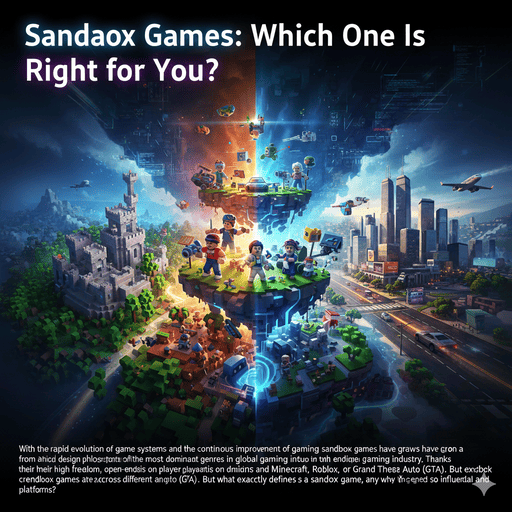
With the rapid evolution of game systems and the continuous improvement of gaming hardware, sandbox games have grown from a niche design philosophy into one of the most dominant genres in the global gaming industry. Thanks to their high degree of freedom, open-ended gameplay, and emphasis on player creativity, sandbox games attract millions of players across different ages, cultures, and platforms.
Even if you have never played a sandbox game yourself, chances are you are already familiar with names like Minecraft, Roblox, or Grand Theft Auto (GTA). But what exactly defines a sandbox game, and why has this genre remained so influential for so many years?
The term “sandbox” originally comes from the idea of children playing freely in a sandbox—there are no fixed rules, no predefined objectives, and no single “correct” way to play. When applied to game design, this concept evolved into a genre centered on player freedom and systemic interaction.
From a strict academic perspective, the earliest sandbox games were closely related to simulation games. However, as game design matured, the definition expanded. Today, any game that allows players to significantly influence the game world through their actions can be considered a sandbox game.
According to the academic journal Game Studies, sandbox games typically share several core characteristics:
Rather than focusing on linear progression, most sandbox games prioritize survival, exploration, and creation, allowing players to define their own goals and experiences.
When discussing the rise of sandbox games, one franchise stands out as a turning point: Grand Theft Auto (GTA).
In a retrospective analysis, IGN described the GTA series as follows:
“GTA redefined what open-world freedom means in modern video games.”
Instead of forcing players to follow a strict mission order, GTA presented a living city where players could drive, explore, interact, or simply exist within the world. This approach fundamentally changed how players understood freedom in games and helped sandbox design achieve massive commercial success.
In the 2010s, the genre evolved even further. With better online infrastructure and accessible creation tools, sandbox games began shifting from “open worlds” to player-created worlds.
Roblox is not just a game—it is a full-scale user-generated content ecosystem. According to official Roblox reports, the platform now hosts hundreds of millions of monthly active users worldwide.
In Roblox, players are both consumers and creators. Everything from characters and clothing to game rules and entire virtual worlds can be built by the community.
Technology outlet The Verge once noted:
“Roblox is closer to a metaverse platform than a traditional video game.”
Its cross-platform support—covering PC, mobile devices, consoles, and VR—further enhances its social and creative potential, making it especially popular among younger players and aspiring developers.
If Roblox represents social-driven creativity, Minecraft stands as a symbol of pure creative freedom.
At first glance, Minecraft’s blocky visuals may appear simple, but they enable extraordinary depth. Players gather resources, craft tools, defend against hostile creatures, and build everything from basic shelters to massive architectural landmarks.
In a feature on Minecraft’s cultural impact, The New York Times described the game as:
“A digital LEGO set for an entire generation.”
Today, Minecraft is used not only for entertainment, but also for education, architecture simulation, and artistic expression—far beyond the boundaries of traditional gaming.
The true appeal of sandbox games is difficult to capture with words alone. As many game designers and researchers have pointed out, the essence of sandbox games lies in possibility rather than content.
These games create parallel worlds where players can follow real-world logic—or completely ignore it. You can replicate everyday life, experiment with impossible ideas, or invent entirely new ways to interact with a virtual environment.
This player-driven philosophy is why sandbox games continue to dominate the industry and are likely to remain a core pillar of game design for years to come.
If you enjoy social interaction, creativity, and community-driven content, Roblox may be your best choice. If you prefer exploration, building, and immersive world design, Minecraft offers unmatched freedom. And if you value realism and open-city experiences, GTA remains a genre-defining classic.
There is no single “best” sandbox game. What truly matters is this: what kind of player do you want to be in the world you choose to explore?
ALL RIGHTS RESERVED AppsMinder.com 2025